
24/7 emergency call line+1 (207) 419-2600
Brentwood Plumbing & Heating logo
Toggle navigation

Brentwood plumbing service

Water Heater Repair in Brentwood, CA

Diagnosis and repair for no hot water, temperature swings, noise, leaks, pilot or ignition faults, and sediment-related performance.

Share the affected fixtures, when the problem began, access details, and any active water or safety concern.

No hot water can come from a simple control issue, a failed heating component, a gas or electrical fault, heavy sediment, or a tank that has reached the end of safe service. Brentwood Plumbing & Heating provides water heater repair in Brentwood, CA for conventional tank and tankless equipment.

The useful question is not only whether a unit can be made to run. It is whether the repair is safe, proportionate to the condition of the appliance, and likely to provide dependable service. A diagnosis should consider the leak source, fuel or power, venting, temperature control, pressure protection, and visible corrosion.

Water-heater symptoms that deserve attention

Turn off fuel or power and the cold-water supply when the tank is actively leaking or the installation appears unsafe.

  • Hot water runs out much faster than usual
  • Water is only lukewarm or temperature changes unpredictably
  • The tank pops, rumbles, hisses, or bangs
  • Moisture appears at the top, bottom, drain valve, or relief piping
  • A gas burner, pilot, or electronic ignition will not stay operating
  • Tankless equipment shows repeated error codes or reduced flow

Request service

Get your service details ready

For emergencies, call instead of using the form.

This planning form does not send online. Call to request or confirm service.

What is included

The service details behind the call

The exact repair follows the evidence, but these are the problems and deliverables covered by this service guide.

Leak-source and installation safety inspection

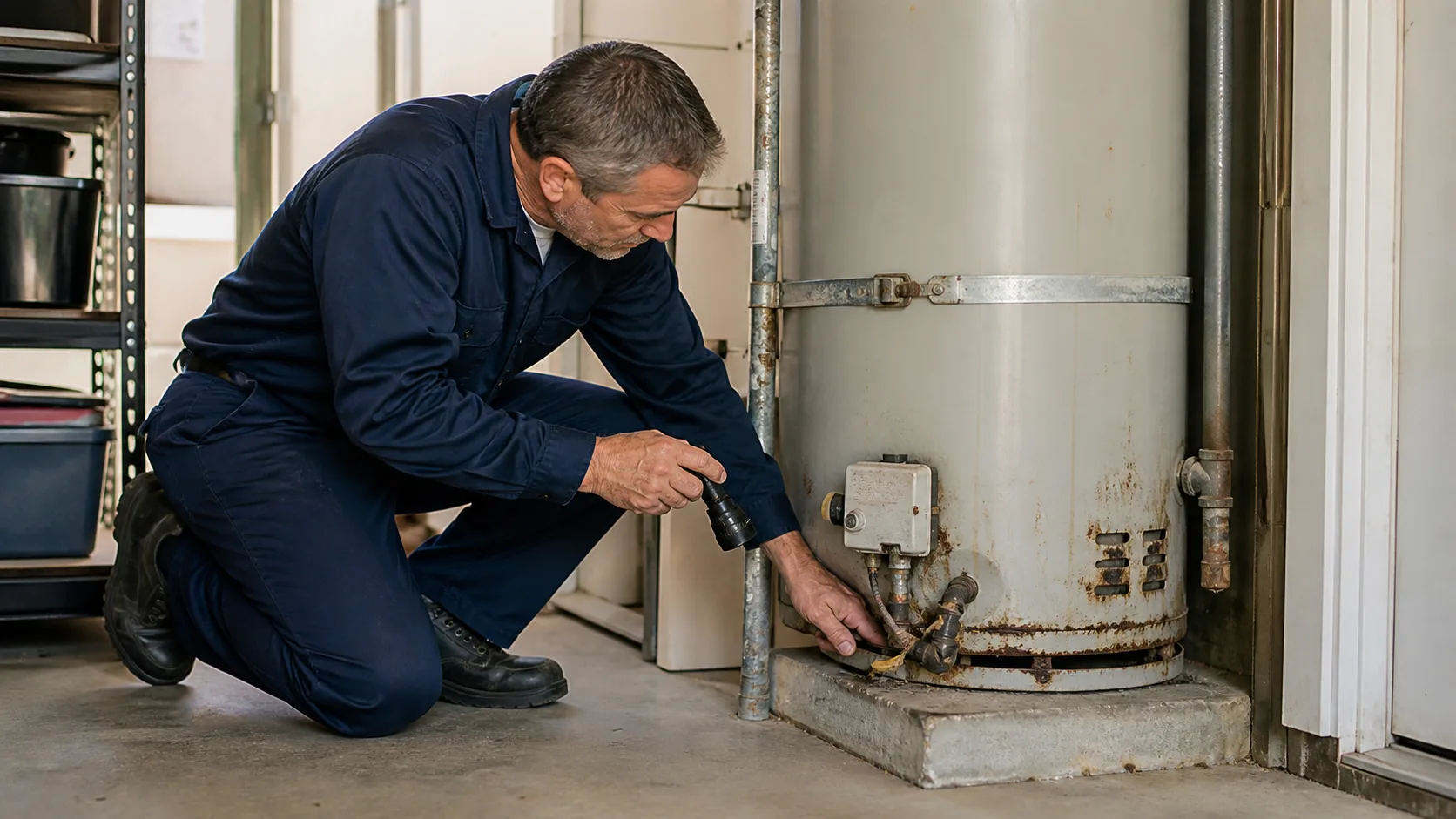
The inspection follows moisture to its highest point and distinguishes inlet or outlet connections, drain valves, relief discharge, pans, nearby piping, condensate, and the storage vessel. Fuel or electrical supply, venting, shutoffs, seismic restraint, drainage, corrosion, and the surrounding area are reviewed before the unit is restarted.

Gas and electric tank diagnostics

Temperature pattern, recovery, thermostat or control behavior, gas ignition and burner operation, or electric element performance are tested according to the equipment type. A repeated breaker trip, abnormal combustion, gas odor, or water around energized parts changes the call from routine troubleshooting to a safety issue.

Tankless flow, code, ignition, and scale diagnosis

The exact error code, inlet filter, flow activation, temperature rise, gas or electrical input, venting, condensate path, and heat-exchanger condition provide more useful evidence than cycling power repeatedly. Descaling is recommended only when condition and manufacturer guidance support it.

Repair, replacement, and commissioning scope

A repair proposal identifies the failed component and post-repair test. When replacement is justified, the comparison includes capacity, energy source, vent or electrical work, valves, drain and relief routing, restraint, permits, removal, and final operation at representative fixtures.

Repair versus replacement without pressure

Service history, tank age, corrosion, leak location, parts availability, capacity, energy source, venting, and installation compliance all affect the decision. A leaking connection may be repairable; water escaping through a corroded tank wall is different and typically points to replacement.

Ask for the failed component and the reason it failed. If sediment or scale contributed, maintenance and water-treatment choices may help the next unit perform more consistently. If household demand has changed, sizing should be revisited rather than automatically replacing like for like.

Hard-water awareness for Brentwood equipment

Mineral content can collect on tank bottoms, heating elements, heat exchangers, aerators, and recirculation components. Symptoms may include noise, reduced recovery, unstable temperature, or restricted flow. Maintenance intervals should reflect actual water conditions and manufacturer instructions.

Flushing is maintenance, not a cure for a corroded tank or failed heat exchanger. Older tanks that have never been flushed require careful evaluation because disturbing heavy deposits can expose existing deterioration.

How the work moves

A clear process from symptom to proof

  1. 1

    Safety check

    Inspect fuel or electrical connections, water leakage, venting, relief protection, and surrounding conditions.

  2. 2

    Performance test

    Measure temperatures, controls, ignition or elements, flow, and recovery behavior.

  3. 3

    Explain options

    Compare repair with replacement based on the failed part and overall equipment condition.

  4. 4

    Restore and verify

    Complete the approved work, test operation, and review maintenance expectations.

Why choose Brentwood Plumbing & Heating

A service scope built around evidence

No license, years-in-business, or review total is published here because those values were not supplied in the verified site configuration. These are the process commitments this page can support.

The symptom is defined before parts are changed

No heat, short hot-water duration, unstable temperature, low tankless flow, noise, and leakage follow different test paths. That distinction reduces guesswork.

Leak location changes the recommendation

A connection or valve can be repairable; a compromised storage vessel is a different condition. The page keeps those outcomes separate instead of treating every puddle as the same failure.

Repair versus replacement uses the whole installation

The failed part is weighed with corrosion, service history, parts availability, demand, venting or electrical capacity, drainage, access, and safety details.

Maintenance advice stays equipment-specific

Flushing and descaling follow manufacturer guidance and actual condition. An older neglected tank is not aggressively flushed on the assumption that maintenance can reverse corrosion.

Honest pricing context

What affects the final scope

No fake flat price can account for diagnosis, access, materials, or related restoration. A useful estimate separates the factors below.

  • Type, capacity, and access to the unit
  • Failed component and parts availability
  • Gas, electric, or tankless diagnostic requirements
  • Venting, drain, seismic, or code corrections
  • Repair versus full replacement scope

Water Heater Repair service areas from Brentwood

Water heater repair from the Brentwood service base supports calls across Downtown Brentwood, Garin Ranch, Shadow Lakes, Deer Ridge / Marsh Creek, Rose Garden, Summerset, Trilogy at the Vineyards, and nearby communities. Larger homes may reveal capacity, recirculation, and long-delivery-path issues; established properties may have older venting, valves, or mixed-era connections. Mineral scale can contribute to noise, restricted tankless flow, and reduced recovery, but the equipment still needs direct testing before scale is named as the cause.

For Oakley, Antioch, and Discovery Bay service inquiries, provide the model and serial label, energy source, exact error code, leak location, approximate installation history if known, and whether all hot fixtures are affected. Include photos of the full installation, vent or electrical connection, drain and relief route, and the path available for replacement equipment. Exact address, safety condition, and current routing determine scheduling.

Clear answers

Water Heater Repair questions

Practical guidance without promises the provided business data cannot verify.

Why is my water heater making popping sounds?

Sediment beneath the water can trap steam and create popping or rumbling. Noise can also come from expanding metal or controls, so the unit should be evaluated before assuming a flush will solve it.

Can a leaking water heater be repaired?

Leaks at connections, valves, or relief components may be repairable. A tank leaking through its shell or bottom seam generally requires replacement.

Why do I run out of hot water quickly?

A failed element, burner issue, broken dip tube, sediment, undersizing, or higher household demand can reduce available hot water.

Should I flush my water heater?

Follow the manufacturer guidance and consider local water conditions. An older neglected tank should be assessed first because aggressive flushing can reveal existing corrosion.

How much does water heater repair cost in Brentwood?

The verified site data does not publish a flat repair price. Cost varies with tank or tankless design, gas or electrical diagnosis, the failed component, parts availability, access, venting or drain corrections, and whether the storage vessel or heat exchanger has failed. Ask for the diagnostic finding, repair scope, test, and exclusions in writing.

Ready when you are

Request water heater repair in Brentwood

Call +1 (207) 419-2600 or prepare the symptoms, affected fixtures, access details, and safety conditions for a clearer service conversation.

Call +1 (207) 419-2600