
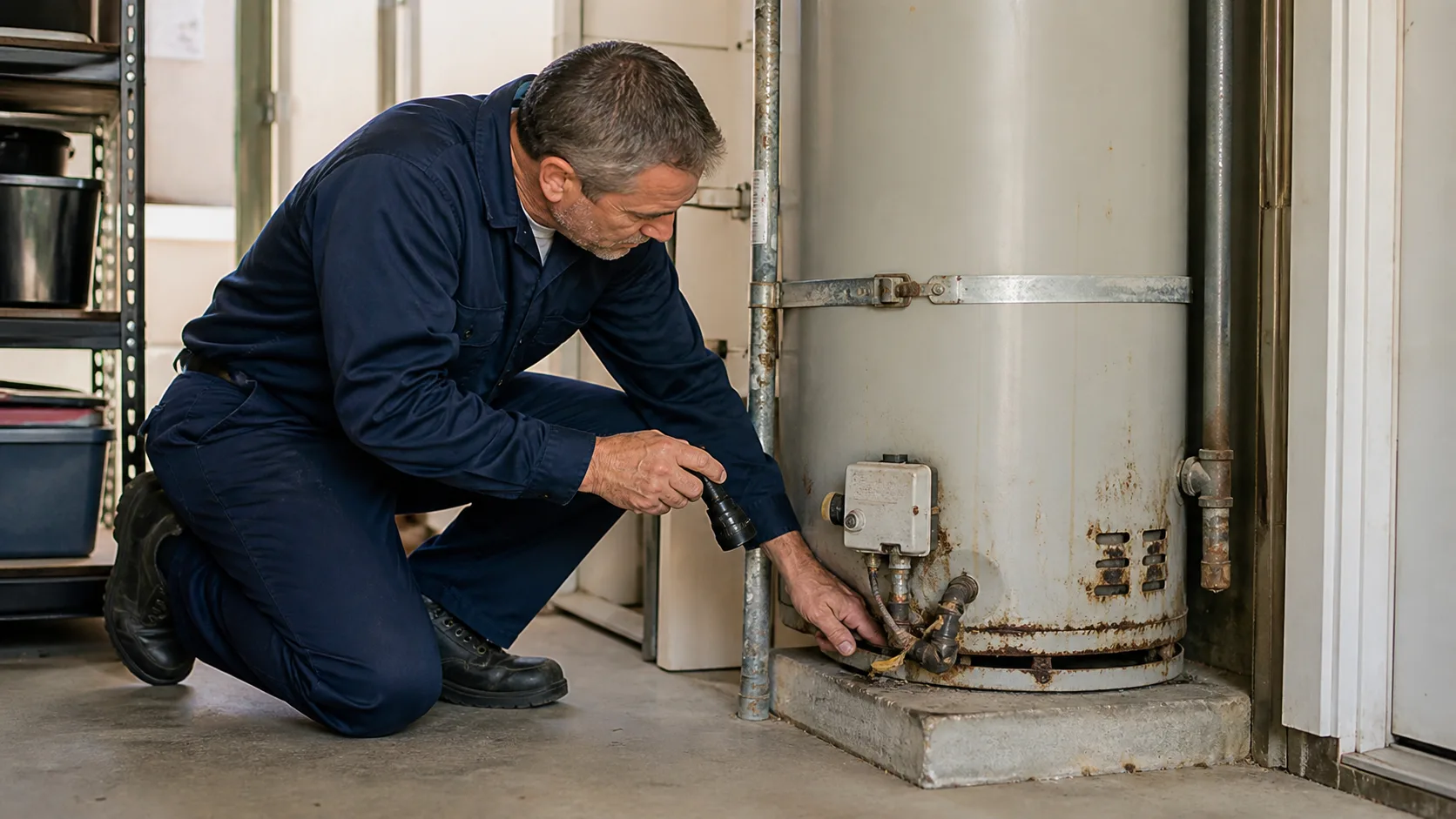
A water heater can usually be repaired when one serviceable part fails and the rest of the system is sound. Replacement becomes the safer value when the tank itself is deteriorating, several components are failing, or the unit can no longer meet the household's needs.
The five signs below are not a remote diagnosis. They are a practical way to decide how quickly to schedule an inspection and which questions to ask. If water is actively escaping from the tank, turn off fuel or power and the cold-water supply if you can do so safely, then request service.
1. The tank shell or bottom seam is leaking
Water at the base does not always mean the tank has failed. A drain valve, relief discharge, inlet, outlet, or nearby pipe can drip and run down the jacket. Dry the visible area, avoid touching energized equipment, and look for the highest point where moisture appears.
Water coming through a corroded tank wall or bottom seam is different. The storage vessel is not a field-repairable component. Once the shell is compromised, replacement is normally the correct safety decision rather than a patch that hides active corrosion.
2. Hot-water quality or temperature keeps declining
A failed heating element, thermostat, dip tube, burner component, or control can reduce hot water and may be repairable. The pattern matters: no heat at all, lukewarm water, short duration, and unstable temperature point to different tests.
Replacement deserves consideration when reduced performance appears with advanced corrosion, several past repairs, or a unit that is poorly sized for the household. A new unit should be sized from realistic simultaneous use instead of automatically matching the old label.
3. Rust appears in hot water or on the tank
Discolored hot water can come from the heater, a sacrificial anode, or piping. Compare hot and cold water after it has been sitting. If only the hot side is affected, the water heater and hot distribution lines deserve closer attention.
Surface rust at a fitting may reflect a small leak above it. Widespread rust around the jacket, combustion area, seams, or multiple connections suggests longer-term moisture. A plumber should identify whether corrosion is external and repairable or evidence of a weakening vessel.
4. Noise returns quickly after maintenance
Popping and rumbling often occur when sediment traps water against the heated surface. Mineral-heavy water can accelerate deposits. Gentle maintenance may help a sound tank, but it cannot restore metal that has thinned or a heat exchanger that is damaged.
Older tanks that have never been flushed need careful evaluation before aggressive cleaning. Deposits can sit over existing corrosion, and a sudden flush may reveal leakage that was already developing. Ask for a condition assessment, not only a maintenance procedure.
5. Repair history is becoming a pattern
One failed valve or control is normal service. Repeated calls for different components, ongoing temperature complaints, recurring ignition faults, or several leaks change the economics. Add the total disruption and reliability risk to the parts-and-labor decision.
Keep model, serial, installation, and repair information near the unit. That record helps verify parts availability and shows whether the current failure is isolated or part of a pattern.
Age and warranty are context, not a remote diagnosis
Manufacturers, equipment types, water conditions, demand, installation quality, and maintenance history produce different service lives. Decode the manufacture date from the model and serial information when possible, but do not replace a sound unit because it crossed a generic birthday. Age becomes more persuasive when it appears with a tank leak, confirmed corrosion, unavailable parts, declining output, or repeated failures.
Check the written equipment and installation warranties before authorizing work. Coverage may distinguish the tank, parts, and labor, and it may require model, serial, original-purchase, registration, maintenance, or authorized-service records. A warranty does not make an unsafe tank serviceable, but it can change how a properly diagnosed repair or replacement is arranged and compared.
Repair-versus-replace questions to ask
Ask which component failed, what evidence supports the diagnosis, and what other major parts were tested. Request separate repair and replacement scopes when both are reasonable. A useful replacement proposal identifies capacity, energy source, venting or electrical needs, drainage, valves, seismic protection, permit considerations, and removal of the old unit.
Do not compare only appliance prices. One proposal may include necessary connection or safety corrections that another leaves out. Clarify finish work, access, permit, disposal, and commissioning so the scopes are truly comparable.
- Is the tank or heat exchanger itself leaking?
- Are replacement parts available?
- Does the unit still fit current household demand?
- Will fuel, venting, electrical, drain, or recirculation work change?
- What maintenance will the new system require?
Brentwood water conditions and maintenance
Mineral scale can affect tanks, elements, heat exchangers, aerators, and recirculation components. White residue and recurring sediment are reasons to test water and review maintenance, not proof that one specific treatment product is required.
A properly sized softener or other treatment system may reduce scale when selected for measured conditions and maintained. Treatment does not replace water-heater inspection, correct installation, or manufacturer maintenance.
Prepare for a productive service visit
Before the visit, photograph the entire water-heater installation rather than only the damaged spot. Include the vent or electrical connection, water lines, shutoff, relief pipe, drain pan, floor, model label, and the route a replacement would take out of the building. Note the number of people in the household, how many showers or appliances run together, and whether hot-water demand has changed since the unit was installed. Those details make capacity and access part of the decision from the beginning.
During the inspection, ask the technician to separate three questions: what failed today, what condition the rest of the system is in, and what the home would need for replacement. A repair quote should name the component and verification step. A replacement quote should show equipment capacity, required connection changes, permit assumptions, disposal, and commissioning. Keeping those scopes separate makes the choice less emotional even when the loss of hot water is inconvenient.
What to do next
If your unit shows one or more of these signs, schedule Brentwood Plumbing & Heating for water-heater diagnosis in Brentwood. You will be in a better position to choose a focused repair or a properly scoped replacement before a small symptom becomes water damage.